
When water is spreading across your floor at 2 a.m., you do not need a sales pitch. You need a crew that knows what they are doing, knows your neighborhood, and can be there fast. That is exactly what we do.
We have restored homes across the Omaha metro through burst pipes in January cold snaps, flooded basements after Papillion Creek overflows, and sewage backups in century-old Dundee bungalows. This page explains our process, what you should do right now, and what to realistically expect from your insurance claim.
Why Water Damage in Omaha Is Its Own Animal
Omaha's climate creates a year-round cycle of water damage risks that homeowners in milder states simply do not face.
- January and February bring lows of -10F to -20F. Uninsulated pipes in exterior walls, crawl spaces, and attached garages freeze and burst without warning. We routinely answer calls from Elkhorn and La Vista homeowners who woke up to a ceiling-fed waterfall from a burst supply line.
- March and April are the peak basement-flooding window. Rapid snowmelt saturates the heavy clay soils throughout west Omaha and overwhelms sump pumps in newer subdivisions. La Vista homes, which are almost entirely sump-pump-dependent, are especially vulnerable if power flickers during a late-winter storm.
- May through July brings severe thunderstorms, the occasional derecho, and wind-driven rain that finds every gap in a roofline or window seal. Homes near Papillion Creek, including large sections of Papillion and Bellevue near the Missouri River floodplain, face flash flooding that can dump several inches of water into a finished basement in under an hour.
- Late summer flash floods along Papillion Creek hit hardest after back-to-back heavy downpours when the ground is already saturated.
Older neighborhoods add a separate layer of risk. Ralston's aging sewer laterals back up regularly, turning a basement into a Category 3 (sewage-contaminated) loss. Dundee and Benson homes, many of them over 100 years old, have foundation walls and drainage systems that were never designed for modern rainfall intensity.
What To Do When a Pipe Bursts in Omaha's Deep Freeze
The first 15 minutes matter more than most homeowners realize. Here is what to do before our crew arrives.
- Shut off the main water supply. Know where your shutoff is before winter arrives. In most Omaha homes it is in the mechanical room near the water heater or in the crawl space.
- Turn off electricity to affected areas. If water is near outlets, panel boxes, or ceiling fixtures, cut power at the breaker. Do not guess. Shut it off.
- Open cabinet doors under sinks on exterior walls to let heated air reach the pipes and slow further freezing.
- Move valuables and electronics off the floor and start documenting everything with your phone. Timestamped photos and video are your best friend during the insurance claim.
- Do not use a shop vac on standing water if there is any chance electricity is involved.
- Call us. The faster extraction begins, the smaller the scope of structural drying and the lower your overall claim.
We carry industrial extraction equipment and can typically be on-site in Omaha proper within the hour.
Our Water Damage Restoration Process, Step by Step
We do not just pull up carpet and point fans at the wall. Our process follows IICRC S500 standards and is fully documented for your insurance company.
1. Emergency Extraction
We remove standing water using truck-mounted and portable extractors. Speed here directly limits how far moisture migrates into subfloors, wall cavities, and insulation.
2. Moisture Mapping
We use thermal imaging cameras and calibrated moisture meters to find water that has already wicked into framing, drywall, and concrete. Water that is not found is water that becomes mold.
3. Structural Drying
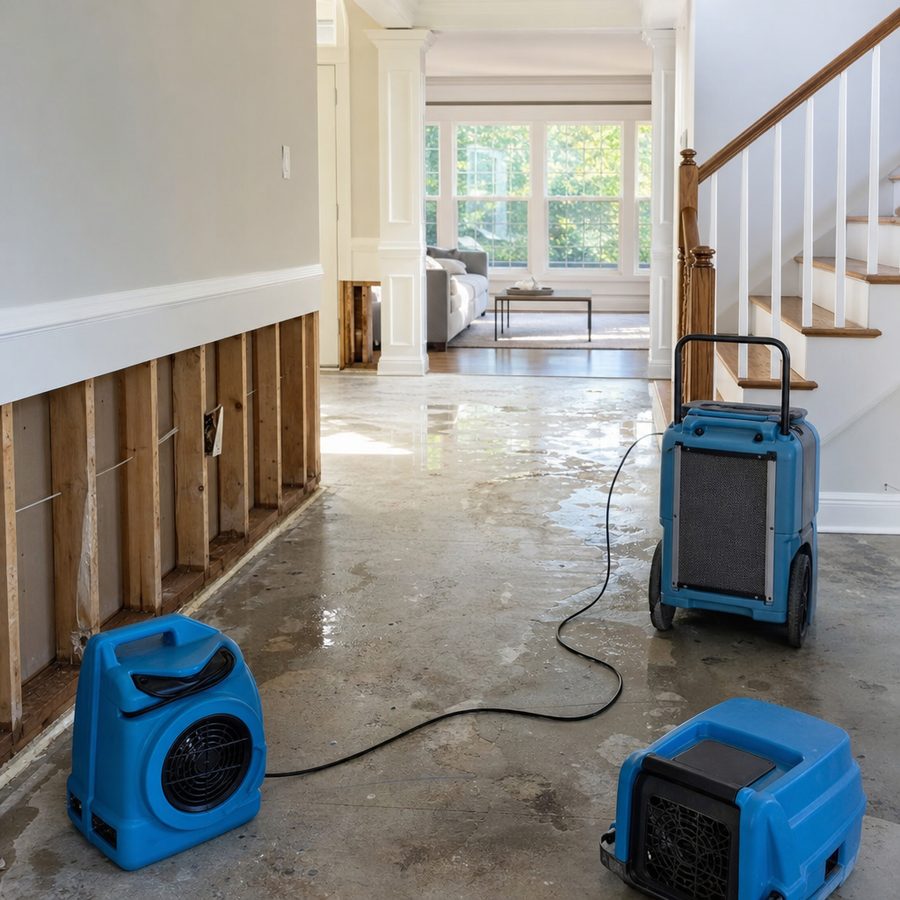
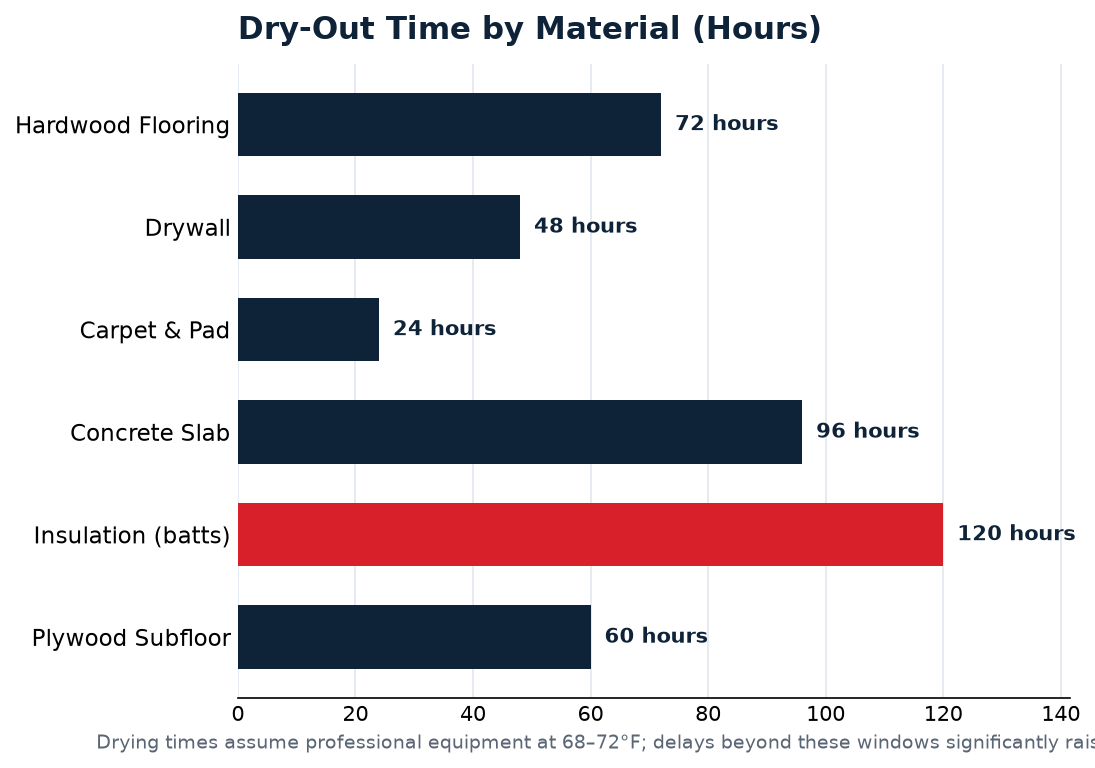
We set industrial-grade air movers and low-grain refrigerant (LGR) dehumidifiers in a calculated configuration. We monitor readings daily and adjust equipment placement until all materials reach their dry standard. This typically takes three to five days depending on the severity of the loss.
4. Mold Inspection and Testing
Standing water and elevated humidity create conditions for mold growth within 24 to 72 hours. After drying is complete, we conduct a thorough mold inspection and testing protocol to confirm no hidden colonies are forming in wall cavities or beneath flooring. If mold is present, we handle remediation in-house so you are not coordinating between two separate companies.
5. Controlled Demolition (When Necessary)
Saturated drywall, insulation, and flooring that cannot be dried in place are removed cleanly and documented. We photograph every cut and every material removed.
6. Rebuild and Restoration
Our crews handle the rebuild from framing and insulation to drywall, paint, and flooring reinstallation. You deal with one company from the first call to the final walkthrough.
Can Water-Damaged Hardwood Floors Be Saved?
This is one of the most common questions we get, and the honest answer is: sometimes yes, sometimes no, and the timeline is the deciding factor.
Solid hardwood can be dried in place if we get to it within 24 to 48 hours and the moisture content has not caused significant cupping or buckling. We use specialty drying mats that pull moisture from below the floor without the destructive tearout that some contractors default to.
Engineered hardwood and laminate are far less forgiving. Once the core swells, it generally cannot be restored and must be replaced.
The factors that determine salvageability include:
- How long the floor was wet before extraction began
- Whether the subfloor underneath is also saturated
- The species and finish of the wood
- Whether the water source was clean supply water or contaminated (sewage backup or floodwater always requires removal)
We will give you an honest assessment on-site, not a guess over the phone.
Water Damage and Your Homeowner's Insurance
Most standard homeowner policies in Nebraska cover sudden and accidental water damage, including burst pipes. They typically do not cover flooding from an outside water source (that requires a separate flood policy, which is especially important for Bellevue and Council Bluffs homeowners in FEMA-mapped flood zones).
Here is what helps your claim move faster:
- Document everything before cleanup begins
- Keep a record of all calls and communications with your insurer
- Get a written scope of work from us before any repairs begin
- Understand that your insurer may send their own adjuster, and our documentation is your evidence
We work directly with all major insurance carriers and can communicate with your adjuster on your behalf.
Frequently Asked Questions
How quickly does mold start growing after a flood? Mold can begin colonizing within 24 to 72 hours in warm, humid conditions. Omaha's summer humidity accelerates this significantly. This is why we treat every water loss as time-sensitive and include mold inspection and testing as a standard step in our process.
My basement flooded from Papillion Creek overflow. Does my homeowner's insurance cover that? Probably not. Flooding from an external water source, including creek overflow, storm surge, or surface water intrusion, requires a separate flood insurance policy through the National Flood Insurance Program (NFIP) or a private carrier. If you live near the Papillion Creek watershed, we strongly encourage you to review your coverage before storm season.
How long will the drying process take? Most residential water losses take three to five days of active structural drying. Finished basements in Millard with multiple affected rooms, or older homes in Ralston or Benson with compromised drainage, can run longer. We provide daily moisture readings so you can see the progress in real numbers.
Can I stay in my home during restoration? In most cases, yes. The equipment is loud and the space is disrupted, but it is rarely necessary to vacate unless there is confirmed sewage contamination, significant mold presence, or structural concerns.
What is the difference between water mitigation and water restoration? Mitigation refers to stopping the damage and drying the structure. Restoration refers to rebuilding and returning your home to its pre-loss condition. Many companies only do one or the other. We handle both, which means fewer handoffs and a faster path back to normal.
If water is in your home right now, call us. We answer 24 hours a day, every day, including holidays. Our crews are local, our response is fast, and we will be straight with you about what your home needs.