
When water gets into your home, the clock starts immediately. Within 24 to 48 hours, wet framing, subfloor, drywall, and insulation become a breeding ground for mold. Our crews handle structural drying across the greater Omaha metro every day, and we want you to understand exactly what we do, why it matters in this specific region, and what you should be doing right now while we're on the way.
Why Structural Drying Is Different From Just Running Fans
Mopping up standing water is the easy part. The real problem is moisture that has wicked into building materials you cannot see. In a typical Omaha home, water from a burst pipe or basement flood absorbs into:
- Oriented strand board (OSB) subfloor and wall sheathing
- Fiberglass and cellulose insulation inside wall cavities
- Concrete block foundation walls common in older neighborhoods like Dundee and Benson
- Finished drywall and the wooden framing behind it
- Hardwood flooring systems (more on that below)
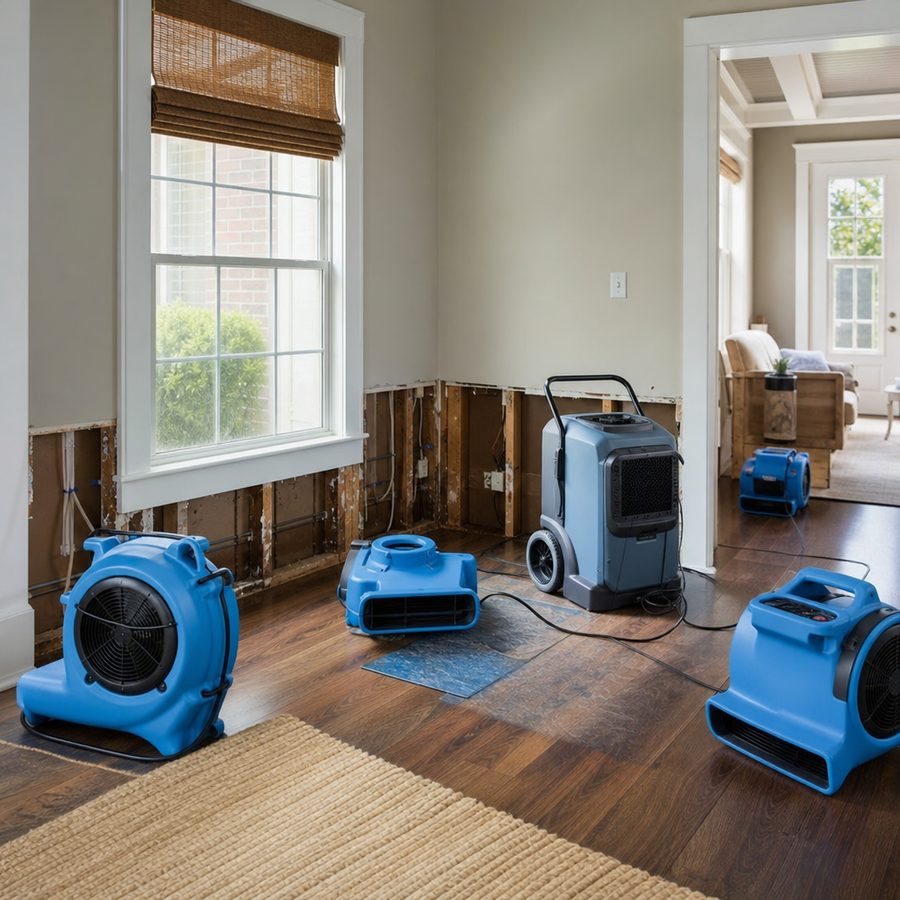
Standard fans push humid air around the room. Professional structural drying uses calibrated drying systems, including commercial-grade air movers and refrigerant or desiccant dehumidifiers, to actually pull moisture out of materials at a measurable rate. We track moisture content with penetrating and non-penetrating meters throughout the job so we can prove, with numbers, that materials have reached a safe drying goal before we close walls.
How Omaha's Climate and Geography Raise the Stakes
Omaha is not a mild environment for water damage. A few local realities that shape how we approach every job:
Winter pipe bursts. When temperatures drop hard in January and February, pipes in exterior walls, crawl spaces, and garages freeze and burst. We regularly respond to calls in La Vista and Millard where sump-pump-dependent homes see the pump freeze solid overnight, and finished basements flood before anyone wakes up.
Papillion Creek watershed flooding. Homes near Papillion Creek and its tributaries face serious flash-flood risk during heavy spring and summer rain events. Water doesn't just come in through doors. It pushes through foundation cracks and floor drains under hydrostatic pressure.
Clay soils in Elkhorn. West Omaha's expanding communities are built on heavy clay soil that holds water against foundation walls for days after a storm. That sustained pressure means a slow, steady intrusion that saturates insulation and bottom plates gradually, sometimes without any obvious puddles to tip you off.
Aging infrastructure in Ralston and Benson. Older housing stock means aging sewer laterals that back up into floor drains and laundry tubs. Sewage-category water (what the industry calls Category 3) requires a more aggressive drying and disinfection protocol than clean water from a burst supply line.
Missouri River floodplain risk near Bellevue and Council Bluffs. Homes in the floodplain can experience groundwater intrusion and surface flooding that lasts for days, not hours. Extended saturation changes our drying calculations significantly.
What To Do When a Pipe Bursts in Omaha's Deep Freeze
If a pipe has burst and you have water running, do these things in order:
- Shut off the main water supply valve. Know where yours is before this happens.
- Cut power to any circuits that serve the affected area at the breaker panel.
- Call us. The faster we arrive, the more material we can save.
- Document everything with photos and video before moving anything. Your insurance adjuster will need this.
- Move furniture, electronics, and valuables to a dry area if it is safe to do so.
- Do NOT run your HVAC system to try to dry things out. In winter, this can push humid air into cold wall cavities and create condensation in places you don't want it.
We will take it from there.
Can Water-Damaged Hardwood Floors Be Saved?
This is one of the most common questions we get, and the honest answer is: sometimes yes, but time is everything.
Solid hardwood is more forgiving than engineered flooring because it can be dried, re-acclimated, and re-sanded. Engineered flooring with a thin veneer layer delaminates quickly when wet and is often a replacement situation. Here is what affects the outcome:
- How long the floor has been wet. Under 24 hours gives us real options. Over 72 hours, we are usually planning for replacement.
- What kind of water. Clean water from a supply line is very different from a sewage backup. Contaminated water means the flooring is a loss from a hygiene standpoint regardless of structural condition.
- The subfloor condition. Even if the hardwood can be saved, a saturated OSB or plywood subfloor may need to come up to dry the framing below it.
We use drying mats and specialty equipment designed specifically to draw moisture out of hardwood from below. We monitor daily until moisture readings stabilize within acceptable range for Omaha's typical indoor relative humidity.
Mold Inspection and Testing: When It Enters the Picture
If water damage sat for more than 48 hours before being discovered, or if there is any visible discoloration or musty odor, mold inspection and testing become part of the conversation. A few things homeowners in Douglas County should know:
- Douglas County requires licensed mold assessment for larger remediation jobs. We work with certified mold assessors and can connect you with one if your situation requires it.
- Nebraska has no statewide mold licensing law, which means the quality signal to look for in any contractor is IICRC certification. Our applied microbial remediation and structural drying certifications are current.
- Mold inspection and testing gives you a baseline measurement before remediation and a clearance measurement after. That documentation protects you when you sell the home.
What Our Structural Drying Process Looks Like Step by Step
- Emergency extraction. We remove standing water with truck-mounted and portable extractors. This is the fastest phase.
- Moisture mapping. We read moisture levels throughout the structure to define the full drying zone, which is almost always larger than the visibly wet area.
- Controlled demo if needed. We remove saturated drywall, insulation, and flooring only as needed to expose wet framing. We keep cuts as small as possible.
- Equipment placement. Commercial air movers direct airflow across wet surfaces. Dehumidifiers remove the vapor those air movers release into the air.
- Daily monitoring. We return each day, read moisture levels, and adjust equipment placement. Drying is not a set-it-and-forget-it process.
- Documentation and drying report. We produce a written report with daily readings. You get a copy. Your insurance adjuster gets a copy.
- Reconstruction coordination. Once materials reach drying goals, we coordinate or perform the rebuild.
Costs and Insurance
Most homeowner policies cover sudden and accidental water damage. Flood damage from rising groundwater or river overflow typically requires a separate flood policy. Slow leaks that were ignored may be disputed. We document everything in a format compatible with Xactimate, the estimating software most insurance adjusters use, which helps move your claim forward efficiently.
City of Omaha permits may be required when structural drying leads to reconstruction. We handle permit coordination so you don't have to figure that out in the middle of an emergency.
Frequently Asked Questions
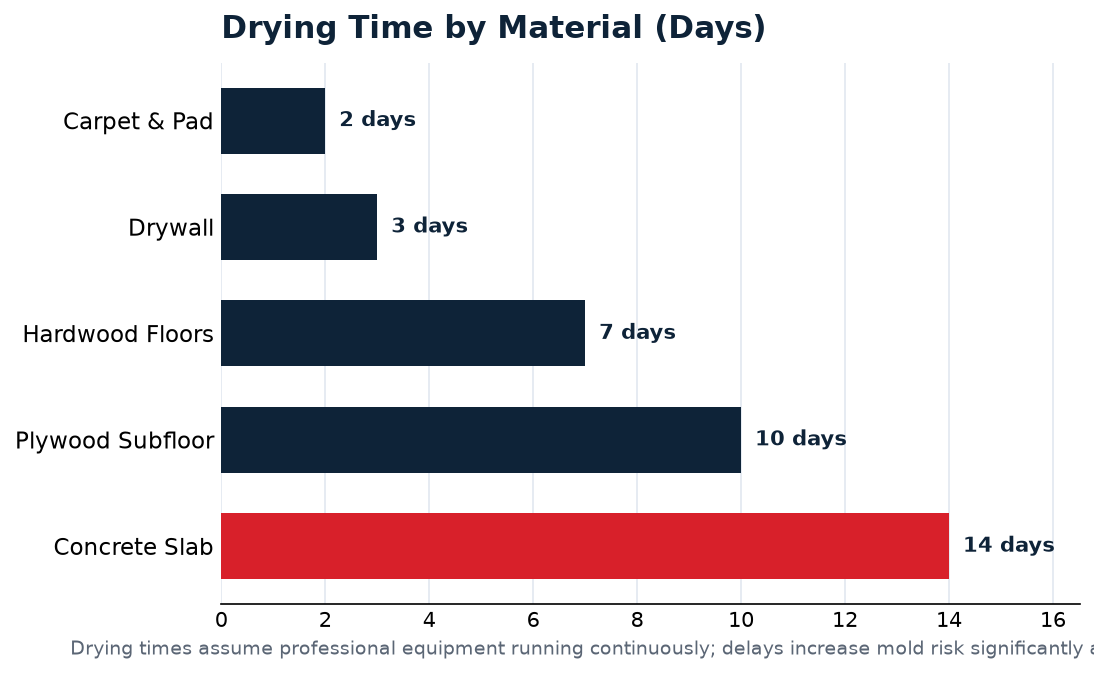
How long does structural drying take? Most residential jobs reach drying goals in three to five days under normal conditions. Larger losses, concrete-heavy structures, or homes with sustained saturation (common in Bellevue's floodplain) can take longer.
Do I have to leave my home during drying? Usually not. The equipment is loud and runs continuously, but most families stay in unaffected parts of the house. We'll tell you honestly if conditions require temporary relocation.
Will my insurance cover the cost of a mold inspection and testing? Sometimes, if mold growth is a direct result of a covered loss. We recommend calling your adjuster early and asking specifically about mold assessment coverage.
My basement in Millard has been wet before and we just dried it ourselves. Why do we need professionals now? Repeated DIY drying without moisture verification often leaves residual moisture in wall cavities and under flooring. Over time this leads to mold growth, rot, and structural damage that costs far more to fix than a professional drying job would have.
What should I do about sewage backup in a Sarpy County home? Call us immediately. Category 3 water requires protective equipment, antimicrobial treatment, and specific disposal protocols. Sarpy County also recommends homeowners in sewage-backup-prone areas install a backwater valve. We can advise you on that once the emergency is resolved.