
When a storm tears shingles off your roof, a tree limb crashes through a window, or a fire leaves your walls exposed to the sky, every hour without protection multiplies the damage inside your home. Our crews respond to these calls around the clock because we know what Omaha weather does to an unprotected structure overnight. Board up and tarping services are not a luxury or a formality. They are the first and most critical step in limiting your total loss.
Why Immediate Protection Matters in Omaha's Climate
Omaha sits in a part of the country where weather swings are extreme and fast. January lows regularly drop to -10F or -20F, meaning an unboarded window or an open roof cavity can let freezing air pour into a home within minutes. Pipes that were fine before the damage event can freeze and burst hours later, adding a water loss on top of your original emergency. In May through July, a derecho or severe thunderstorm can push wind-driven rain horizontally through any opening larger than a fist.
We have responded to homes in Dundee where a century-old tree fell through the attic during a late-spring storm, and by the time the homeowner called us the following morning, a secondary rain event had soaked two floors of plaster walls and hardwood flooring. That secondary damage was entirely preventable with same-night tarping. Getting a professional tarp or board in place within hours, not days, is the difference between a manageable claim and a rebuild.
What Our Board-Up and Tarping Process Looks Like
We do not show up with a roll of plastic from a hardware store and call it done. Here is what a professional response actually involves.
Step 1: Damage Assessment Our crew walks the full perimeter and interior before touching anything. We photograph every opening and document conditions for your insurance adjuster. This documentation is yours to keep.
Step 2: Structural Stabilization If a vehicle, falling tree, or structural failure has compromised a wall, we assess whether the structure is safe to work on before we send anyone onto a roof or into a damaged room.
Step 3: Roof Tarping We use heavy-duty polyethylene tarps (typically 6-mil or thicker) secured with dimensional lumber along the ridge and eaves. The tarp runs past the ridge line so wind cannot lift the leading edge. A tarp stapled loosely to decking is not a tarp. Ours stay put through another round of storms.
Step 4: Window and Door Board-Up We cut plywood to fit each opening precisely, fasten it into framing studs (not just siding), and seal edges with foam tape where wind-driven rain is a concern. For Dundee and Benson homes with original wood framing, we take extra care not to damage irreplaceable millwork in the process.
Step 5: Reporting and Handoff We provide a written scope of work to you and, if you want, send it directly to your insurance carrier. We also note any conditions, such as active moisture intrusion or signs of mold growth, that need to be addressed in the next phase of restoration.
Omaha-Specific Hazards That Make Fast Response Essential
Different parts of the metro face different threats, and our response is calibrated accordingly.
- Papillion and La Vista: Flash flooding along Papillion Creek after a heavy downpour can compromise foundation walls and push water through basement window wells. A board-up on a broken egress window keeps the second wave of rain out while we assess the water intrusion below.
- Bellevue and Council Bluffs: Homes near the Missouri River floodplain may face combined wind and flood events. A storm that damages a roof and saturates the ground simultaneously creates multiple entry points for water.
- Millard: Finished basements are common here, and they are expensive to restore. Keeping the building envelope sealed after an event above grade protects the investment below grade.
- Elkhorn: Clay soils hold water and expand, which stresses foundations and window wells. After a storm event, an open basement window can funnel both rainwater and groundwater inside.
- Ralston and Benson: Older housing stock means aging materials that absorb moisture faster than modern construction. A delay of even 24 hours can mean the difference between salvageable framing and framing that needs replacement.
What To Do Right Now Before We Arrive
You can take a few safe steps immediately after the emergency.
- Stay away from structural damage. Do not walk under a compromised roof section or lean against a damaged wall.
- Turn off electricity to affected areas if water is present or wiring is exposed. Call your utility if you are unsure.
- Move valuables and documents away from the open area if you can do so safely and quickly.
- Call your insurance company and let them know emergency board-up and tarping services are being arranged. Most standard homeowner policies cover these costs as part of the claim.
- Document with your phone. Wide shots and close-ups of every opening and all visible damage help your adjuster and reduce disputes later.
- Do not attempt to tarp a roof yourself. After a storm, decking may be wet, soft, or partially detached. Falls are the most common secondary injury we see.
Costs, Insurance, and What to Expect
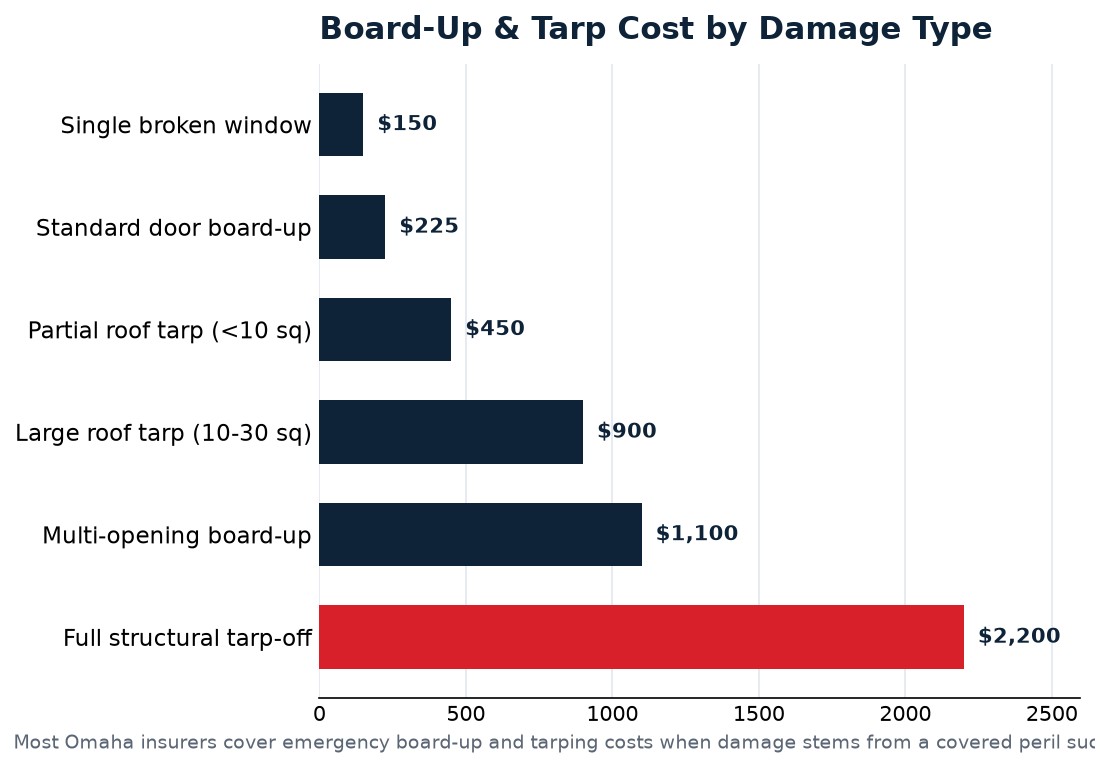
Board up and tarping costs vary by the number of openings, roof pitch, and how much lumber and material is required. A single broken window board-up runs a few hundred dollars. A large roof opening after a tree strike can run higher. In most cases, your homeowner's insurance policy covers emergency protective measures under your dwelling coverage, and we document everything in the format most adjusters prefer.
We work directly with most major carriers and can walk you through the process if this is your first significant claim. If we identify conditions that point toward a larger scope, such as water-damaged subfloor, possible mold inspection and testing needs, or questions like whether your water-damaged hardwood floors can be saved, or what to do when a pipe bursts during one of Omaha's deep freezes, we explain the next steps clearly before any additional work begins.
Frequently Asked Questions
How fast can you get to my home? We aim to be on-site within two to four hours for most Omaha metro locations, including Bellevue, Papillion, Gretna, and Council Bluffs. Response time can vary during widespread storm events when multiple calls come in simultaneously, but we triage by severity and keep you updated.
Will a tarp hold through another storm? A properly installed tarp using secured lumber and correct overlaps at the ridge will hold through normal rain and moderate wind. If a second major storm is forecast, we will discuss whether additional reinforcement is warranted.
Does insurance actually cover board-up services? In most cases, yes. Emergency protective services are typically covered under the same claim as the original damage event. We provide an itemized invoice in the format your adjuster needs.
What if I am not sure whether I need board-up or just repairs? Call us and describe what you see. We will tell you honestly whether it warrants an emergency response or whether it can wait for a scheduled inspection. We would rather talk you through it than have you make the wrong call in either direction.
What happens after the board-up is complete? The temporary protection buys time for a proper damage assessment. Depending on what we find, next steps may include water extraction, structural drying, mold inspection and testing, or a full restoration scope. We handle all of it in-house and keep you informed at every stage.