
If you have climbed into your attic and found dark patches spreading across the sheathing, or if a home inspector just handed you a report with the word "mold" circled in red, you are not alone. We talk with Omaha homeowners every week who are dealing with exactly this situation. Attic mold is one of the most common hidden problems we uncover in this region, and it is almost always fixable when it is caught and treated correctly.
This page explains what causes attic mold here specifically, what our removal process looks like step by step, what you should do right now, and how insurance and costs typically work.
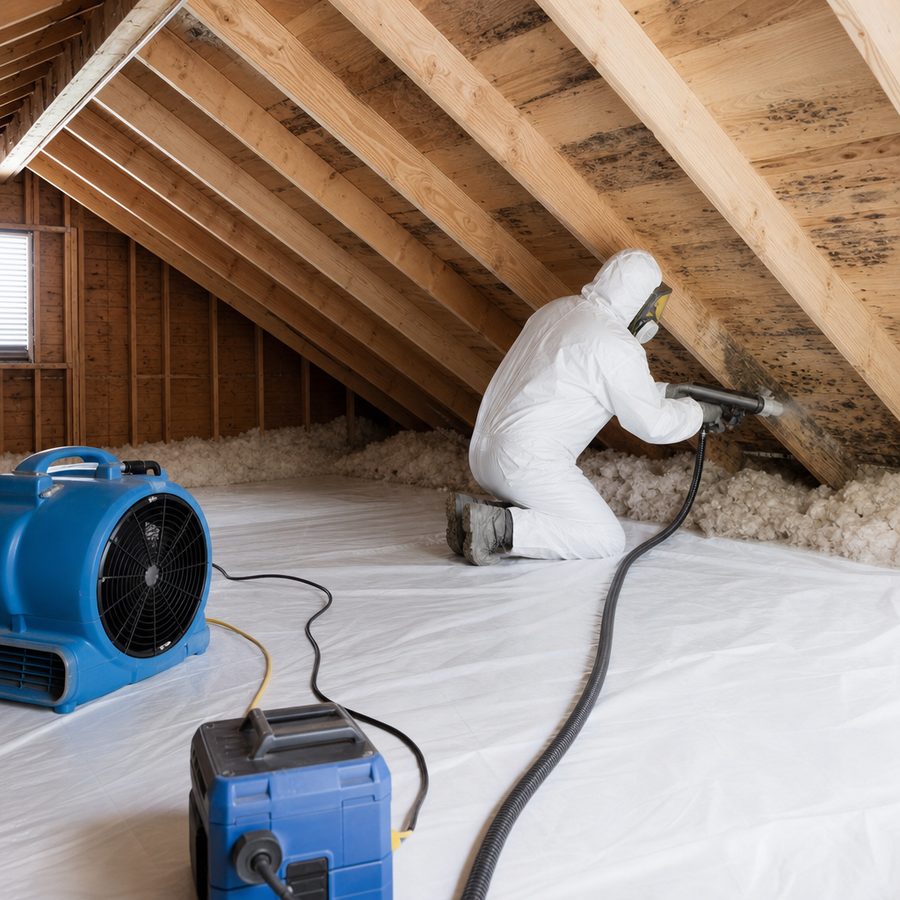
Why Omaha Attics Are Especially Vulnerable
Attic mold does not grow randomly. It grows when three things come together: moisture, a food source (wood), and poor airflow. Omaha's climate creates all three conditions reliably.
Temperature swings drive condensation. Our January lows regularly hit between -10F and -20F. When a poorly sealed attic floor allows warm household air to rise into a frozen attic space, that warm air hits the cold sheathing and roof rafters and condenses. Do this night after night through a Nebraska winter and you are essentially misting your own attic with water.
Our housing stock adds to the risk. We work frequently in Dundee and Benson, where century-old homes were built without the vapor barriers and sealed attic bypasses we take for granted today. In those older neighborhoods, kitchen exhaust fans, bathroom fans, and even recessed ceiling lights can vent warm moist air directly into the attic rather than to the exterior. We have opened attics in Benson homes and found bathroom exhaust ducts that terminated six inches from the roof deck, pumping humidity straight onto the sheathing for years.
Roof and gutter issues accelerate the problem. In Elkhorn and other west Omaha communities built on clay soils, water management around the home is already a challenge. Ice dams that form along roof edges in February and March can allow meltwater to work back under shingles and wet the roof deck from the outside at the same time condensation is wetting it from the inside.
Snowmelt season is critical. The March and April snowmelt window is the peak period for attic moisture loading. A heavy snowpack sitting on a roof that has uneven insulation will create warm spots and cold spots, producing cycles of melt and refreeze that stress the roof deck and introduce moisture repeatedly over several weeks.
Signs You May Have an Attic Mold Problem
- Dark gray, black, or greenish staining on roof sheathing or rafters
- A musty odor when you open the attic hatch
- Frost or ice visible on interior attic surfaces in winter
- Peeling or bubbling paint on second-floor ceilings
- A home inspector flagging "elevated moisture" or "suspect staining"
- Soffit vents that are blocked by insulation (a very common finding)
Our Attic Mold Removal Process
We do not spray paint over mold or slap a coat of encapsulant on stained wood and call it done. Here is what a real remediation looks like from start to finish.
Step 1: Mold Inspection and Testing
We start with a thorough mold inspection and testing phase before any work begins. We visually document all affected areas, take moisture readings throughout the sheathing, and collect air or surface samples when the extent of the contamination is unclear. We send samples to an independent laboratory. This baseline matters because it protects you: you will have objective data proving the space was clean when we leave.
Step 2: Containment and Protection
Our crews seal the attic access point and set up negative air pressure if the mold coverage is significant. We do not want spores disturbed during remediation drifting down into living spaces.
Step 3: Physical Removal
This is the core of the work. We use HEPA-filtered vacuums and hand scrubbing or mechanical sanding to physically remove mold from the wood surface. Mold cannot simply be killed in place on a porous material like OSB or plywood sheathing. The discoloration you see represents fungal hyphae (root-like structures) that have penetrated slightly into the wood fibers. Those have to be removed, not just treated.
Step 4: Antimicrobial Treatment
After the surface is clean and dry, we apply an EPA-registered antimicrobial agent to the treated areas. This is a second layer of protection, not the primary treatment.
Step 5: Correcting the Source
If we remove the mold without fixing what caused it, it will return within one or two heating seasons. We identify and address every moisture source we find: rerouting improperly terminated exhaust fans, adding or clearing soffit and ridge vents, sealing attic bypasses around recessed lights and plumbing chases, and recommending insulation improvements where needed.
Step 6: Post-Remediation Verification
We conduct a final inspection and, when a third-party clearance test is requested, we help coordinate it. You should receive documentation confirming the space passed before you close any walls or sign off on a real estate transaction.
What to Do Right Now
- Do not disturb the mold by scrubbing it yourself. Dry brushing or vacuuming with a standard household vacuum will scatter spores.
- If you have a bathroom or kitchen exhaust fan, check where it terminates. Go into the attic and trace the duct. If it is not connected to a roof cap or gable vent, stop using that fan until it is repaired.
- Take photos of everything you can see from the attic hatch before anyone else enters.
- Call a remediation company for a professional mold inspection and testing assessment. Do not rely solely on a visual inspection if you are in the middle of a real estate transaction.
Costs and Insurance
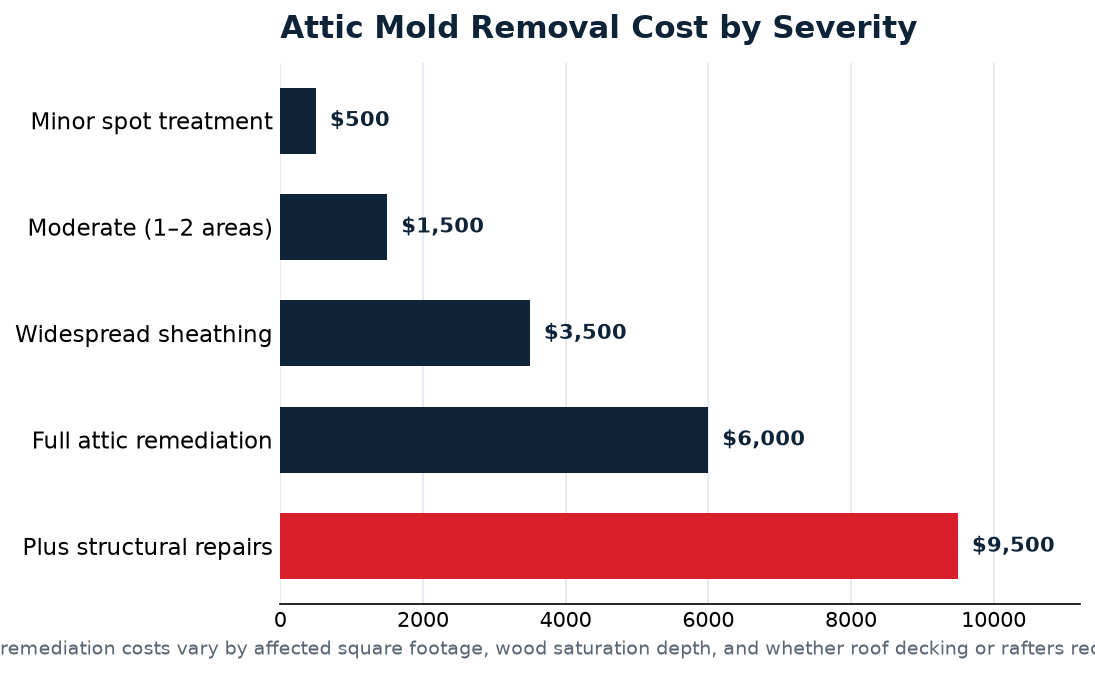
Attic mold remediation in the Omaha metro typically ranges from a few hundred dollars for a small isolated section to several thousand dollars for a full attic with heavy coverage. Variables include square footage of affected sheathing, the source corrections needed, and whether any structural wood needs replacement.
Homeowner's insurance coverage depends entirely on the cause. If the mold resulted from a sudden covered event, such as a burst pipe (which we see frequently in uninsulated attics after those brutal January cold snaps) or storm damage, your policy may cover remediation. If the adjuster determines it was a long-term moisture issue or lack of maintenance, coverage is often denied. We can help you document conditions and work with your adjuster, but we will give you an honest answer about what we see rather than tell you what you want to hear.
Frequently Asked Questions
How long does attic mold removal take? Most residential attic jobs in the Omaha area take one to two days for the remediation itself. Source corrections such as rerouting exhaust fans may require a separate HVAC or roofing contractor and can add time.
Is attic mold dangerous to my family's health? It depends on the species and your household's sensitivities. Mold spores that originate in a moldy attic can migrate into living spaces, particularly if there are air-sealing gaps in the ceiling. People with asthma, allergies, or compromised immune systems are most at risk. We take every case seriously regardless of species.
Can I just paint over the mold with Kilz or a similar primer? No. Encapsulants and primers do not remove the mold; they cover it temporarily. On a porous surface like roof sheathing, the mold will continue to grow beneath the coating. This approach also will not pass a clearance test.
Will the mold come back after remediation? Not if the moisture source is corrected. Mold is a symptom. If we treat the symptom and fix the cause, recurrence is extremely unlikely. If the cause is left unaddressed, it will return.
Do I need a separate air quality test after the work is done? For most residential jobs, our own post-remediation inspection is sufficient. For real estate transactions or situations involving health concerns, we recommend an independent clearance test performed by a certified industrial hygienist. We can refer you to qualified local professionals who are not affiliated with our company so the result is unbiased.