
When water invades your business, every hour counts. Soaked drywall, warped flooring, saturated insulation, and standing water on a concrete slab are not just cosmetic problems. They threaten your inventory, your equipment, your employees, and the structural integrity of the building itself. Our crews have handled commercial water damage restoration across the greater Omaha metro, from warehouse facilities in La Vista to retail storefronts in the Dundee neighborhood, and we understand what it takes to get a business back to full operation as fast as possible without cutting corners.
Why Omaha's Climate and Soil Create Unique Water Damage Risks
Omaha is not a forgiving environment for commercial buildings. A few realities shape almost every job we walk into.
Freeze and thaw cycles. Nebraska winters regularly push temperatures below zero, and the Missouri River corridor amplifies the wind chill. Supply lines, fire suppression pipes, and roof drains that run through unheated spaces are all vulnerable. When a pipe bursts during one of Omaha's deep freezes, water can flow undetected for hours before someone arrives Monday morning to find several inches of standing water across an office floor.
Clay soils in western Omaha. The expanding neighborhoods around Elkhorn sit on heavy clay soil that sheds water rather than absorbing it. During heavy rain events, that water has nowhere to go except against foundation walls, through window wells, or back up through floor drains. We see this pattern repeatedly in newer commercial construction out west where site grading has not fully settled.
The Papillion Creek watershed. Businesses and industrial properties near Papillion and La Vista operate in a flash-flood-prone corridor. A two-inch rain in a single hour can overwhelm storm systems and push water into lower-level loading docks and mechanical rooms before a sump pump has time to respond.
Aging infrastructure in established commercial districts. Older parts of Omaha, including Benson, Ralston, and the historic commercial blocks near Dundee, contain sewer laterals and building drains that are decades past their expected service life. Sewage backups are among the worst category of water damage (IICRC Category 3, or "black water") because they carry pathogens that require specialized decontamination, not just drying.
Missouri River floodplain proximity. Commercial properties in Bellevue and across the river in Council Bluffs face recurring risk from high-water events. Businesses in those areas should have a relationship with a restoration contractor before an event happens, not during one.
What To Do When a Pipe Bursts or Water Enters Your Commercial Building
Act in this order:
- Shut off the water source if it is safe to do so. Know where your main shutoff and zone valves are before an emergency happens.
- Cut power to affected areas only if you can do so without standing in water. If there is any doubt, leave it to the utility or your electrician.
- Call us immediately. Commercial water damage restoration is not a next-business-day problem. Mold can begin colonizing porous materials within 24 to 48 hours.
- Document everything before moving it. Photographs and video of standing water, damaged inventory, and affected equipment support your insurance claim.
- Do not use standard shop vacuums or fans. Moving air through a space contaminated with sewage or mold spores spreads the problem. We use negative-air pressure containment and commercial-grade HEPA filtration for a reason.
Our Commercial Water Damage Restoration Process
We follow the IICRC S500 standard for water damage and the S520 standard for mold remediation. Here is what that looks like in practice on a commercial job.
Step 1: Emergency response and inspection. We arrive, assess the scope, identify the water category (clean, gray, or black water), and use moisture meters and thermal imaging to map hidden saturation in walls, ceilings, and subfloors.
Step 2: Water extraction. Truck-mounted extractors remove standing water far faster than portable units. On large commercial floors we can move thousands of gallons quickly.
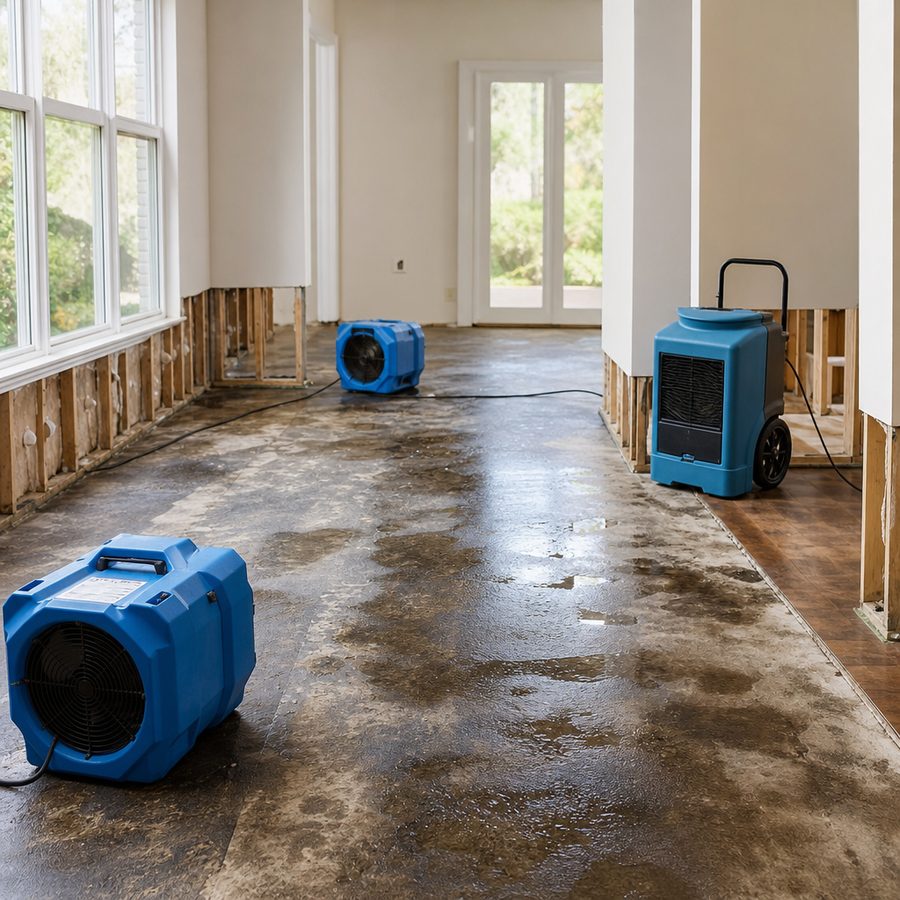
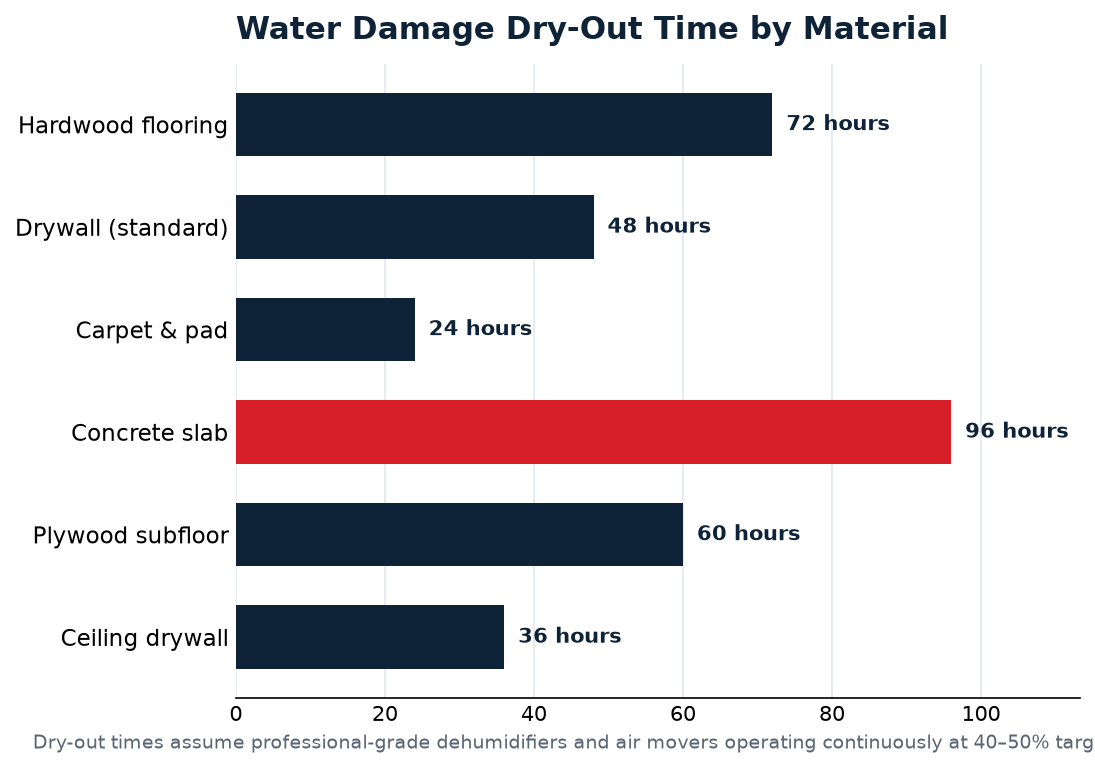
Step 3: Structural drying. Industrial dehumidifiers and air movers are placed according to a drying plan, not just scattered around a room. We monitor moisture readings daily and adjust equipment placement until we reach target dryness levels. The City of Omaha may require permits for structural drying work that involves reconstruction, and we handle that paperwork on your behalf.
Step 4: Mold inspection and testing. If water has been present for more than 48 hours, or if we find visible microbial growth, we conduct a thorough mold inspection and testing protocol. Douglas County requires licensed mold assessment for larger remediation jobs, and our team meets that requirement. Because Nebraska has no statewide mold licensing, IICRC certification is the standard that separates qualified contractors from unqualified ones. Ours are certified.
Step 5: Remediation and reconstruction. Damaged drywall, insulation, flooring, and framing are removed, treated, and replaced to pre-loss condition. We coordinate directly with your insurance adjuster to document scope and pricing.
Can Water-Damaged Hardwood Floors Be Saved?
This is one of the most common questions we hear from restaurant and retail clients. The honest answer is: sometimes yes, sometimes no, and it depends on how quickly we got there.
Solid hardwood that has been wet for less than 48 hours and has not yet buckled or cupped significantly can often be dried in place using specialty drying mats and low-grain refrigerant dehumidifiers. Engineered hardwood is less forgiving because the core layers delaminate when wet.
Hardwood that has been sitting in water for several days, or that shows severe cupping, warping, or mold growth at the tongue-and-groove seams, generally cannot be saved economically. We will always give you a straight assessment rather than a hopeful one.
Costs and Insurance for Commercial Water Damage
Commercial water damage restoration costs vary widely based on square footage, water category, building materials, and how long the water sat. A small office suite affected by a clean-water pipe burst is a very different job from a flooded restaurant kitchen with Category 2 water and laminate subfloor damage.
Most commercial property insurance policies cover sudden and accidental water damage. They typically do not cover flood damage (which requires a separate NFIP or private flood policy) or damage from long-term neglect. Sarpy County building officials recommend backwater valves for sewage-backup-prone commercial properties, and some insurers will reduce premiums or coverage disputes when that mitigation is in place.
We work directly with all major commercial carriers and can provide detailed moisture logs, equipment records, and scope documentation to support your claim.
Frequently Asked Questions
How fast can you respond to a commercial water emergency in Omaha? We offer 24/7 emergency response across the Omaha metro, including Sarpy County communities like Papillion, Gretna, and Bellevue. Our target is to have a crew on site within two hours of your call.
Do we need to close our business during restoration? Not always. For smaller affected areas we can establish containment barriers and maintain drying equipment while portions of your operation continue. We will give you a clear picture of what is safe versus what requires shutdown.
What is the difference between water damage restoration and mold remediation? Water damage restoration addresses the immediate moisture intrusion, extraction, and structural drying. Mold remediation is a separate, regulated process that addresses microbial growth that has already established. Both may be necessary depending on how long water was present. Our team performs both services and coordinates the mold inspection and testing required under Douglas County guidelines.
My building flooded from a sewer backup. Is that treated differently? Yes. Sewage backups are classified as Category 3 (black water) and require full personal protective equipment, antimicrobial treatment, and disposal of porous materials that cannot be adequately decontaminated. This is not a situation for a standard cleaning crew.
Will my insurance cover a burst pipe in the middle of winter? In most cases, yes, as long as the building was maintained and heated reasonably. Insurers sometimes dispute claims when a building was left unheated or when the pipe failure resulted from deferred maintenance. We help you document the loss accurately from the start so those disputes are less likely.